
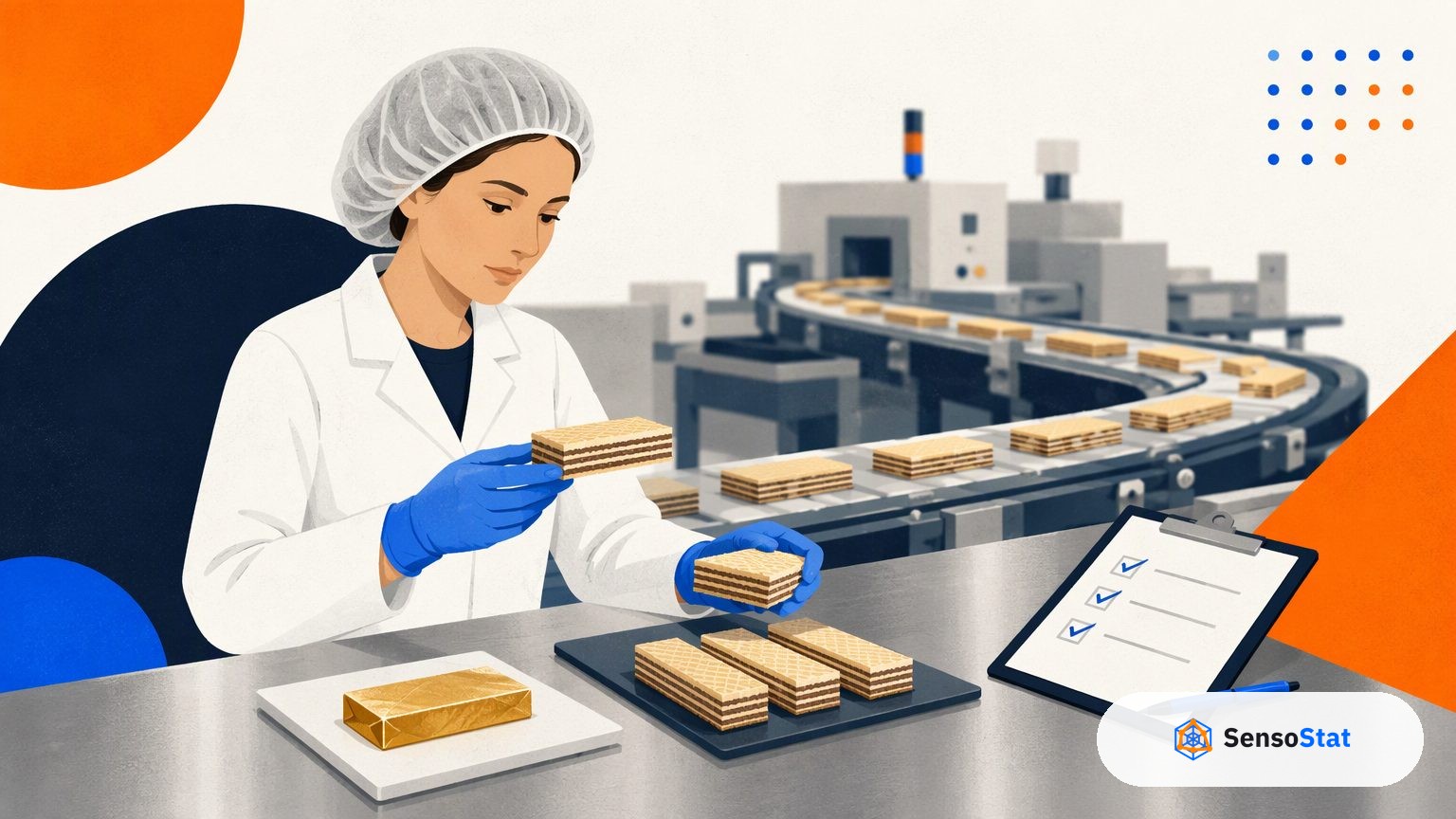
Where sensory analysis works
Food industry
The largest consumer of the methods: recipe development, raw-material supplier selection, batch quality control, shelf life, substantiation of on-pack claims.
Beverages and wine
Professional tasting panels, commodity expertise, competition judging. Terroir, vintages, blending — tasks for descriptive analysis.
Perfumery and cosmetics
Olfactory panels (noses), sensory profiles of creams (texture, spreadability, absorbency, greasiness after application), TDS for fragrance dynamics.
Household chemicals
The smell of detergents, skin feel, the "clean" scent of laundry. Hedonic tests and CATA are the working methods.
Pharma
Taste-masking of medicines, palatability of paediatric forms, evaluation of chewable and lozenge forms. Threshold methods for bitterness.
Textiles and materials
Tactile panels: softness, smoothness, the "hand" of a fabric. Discrimination and descriptive methods without tasting.
Sensory quality control (ISO 20613:2019)
A QC panel answers the question "does the batch match the reference?", not "how does it differ?". Working methods:
- In/Out — conformance to specification on key attributes: fast, for the line;
- Difference from control — the size of the difference from the control sample on a scale; analysis by ANOVA;
- Control charts — regular scoring of the reference by the panel, monitoring the stability of the panel itself over time.
Shelf life: sensory science decides
A product's shelf life is often determined not by microbiology but by sensory failure (sensory shelf-life): the product is safe but stops being pleasant. Approaches: storing samples with regular scoring (fresh control via freezing/preservation), attribute-degradation curves, a consumer acceptability cut-off.
Degradation of key biscuit attributes during storage (a model example)
Product development and marketing
- Benchmarking — a descriptive category map (PCA) shows open niches: "all competitors are sweet and vanilla — there is a window for a sour note";
- Recipe optimisation — JAR + penalty analysis says what to tune (sweetness ↓), and preference mapping — what drives liking;
- The lexicon as an asset — a well-tuned descriptor vocabulary (the module 05 case — a six-descriptor chocolate lexicon) is reused for years and synchronises technologists, QC and marketing;
- Packaging and expectations — sensory tests "branded vs blind" measure the expectation effect; the gap between the blind and the branded score diagnoses the communication;
- The instrumental link — electronic nose/tongue instruments (e.g. "MAG-1" class analysers) correlate with the panel and offload it in routine work, but do not replace it: they are calibrated precisely on sensory data.
Claims substantiation (ISO 20784:2021)
Phrases like "30 % less sugar, same taste", "the crispiest", "preferred by 8 out of 10" are sensory claims that must be provable. The rules:
- a difference claim — a discrimination test in difference mode;
- a similarity claim ("the taste is unchanged") — a test in similarity mode with specified p_d and β;
- a preference claim — a consumer test with a representative sample (not an employee panel!);
- design, sampling and statistics are documented before the start — regulators and courts look exactly at this.
Further reading
- Drake M. A. Sensory Analysis and Consumer Preference: Best Practices, 2023 — how leading companies embed sensory science in QC, NPD and marketing. review
- Module standards: ISO 20613 (sensory QC), ISO 20784 (claims substantiation), ASTM E1958 (sensory substantiation of advertising claims) — live links in the text. standards
- Lawless & Heymann, 2nd ed. — chapters 19–20 (QC and shelf-life) — difference-from-control, control charts, accelerated ageing. book
Test yourself
Three questions on applied sensory science
1. A company wants to print "same taste" on the pack after replacing the sugar. Which test is needed?
A no-difference claim is proven only by a similarity test (ISO 4120:2021, similarity mode; ISO 20784:2021).
2. What usually limits the sensory shelf life of crispy products?
Moisture kills crispness, fat oxidation gives rancidity — the two main mechanisms of sensory failure in crispy products.
3. For QC on a production line, the most practical method is…
QC needs a fast "conforms / not" answer. A full profile is an R&D tool, not a line tool.
One last thing: the reference guide
Module 11: a standards map, a searchable glossary, books and software.